


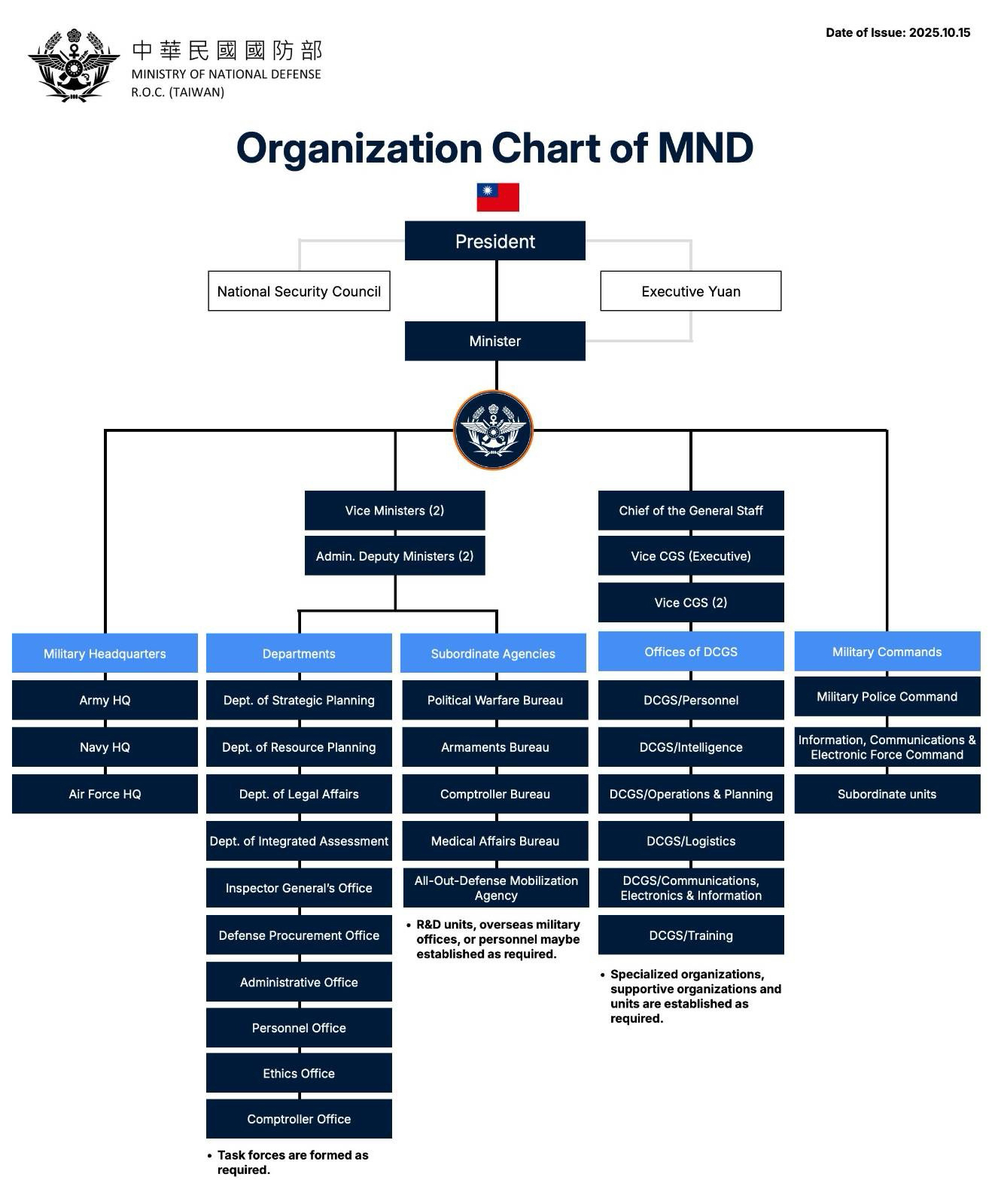
National Defense Organization
I.Hierarchy and Responsibilities of the National Defense Organization
(I)The President
The President shall assume the supreme command of the army, navy, and air force of the ROC as the Commander-in-Chief of the Armed Forces. He or she exerts executive authority over the National Defense Minister, and the Chief of the General Staff (CGS) follows the leadership of the Minister to command the Armed Forces.
(II)The National Security Council
The President may convene the National Security Council to decide major defense policies andguidelines related to national security or in response to urgent defense situations.
(Ⅲ)Executive Yuan
The Executive Yuan is responsible for formulating defense policies, consolidating overall national power, and supervising subordinate agencies handling national defense affairs.
(Ⅳ)Ministry of National Defense
The MND is in charge of national defense affairs. The MND shall perform its policymaking, command, and armament functions, and shall submit suggestions for defense policies and formulate military strategy accordingly.
II.Defense Organizational Structure
According to the National Defense Act, the defense organization is divided into three systems, namely the “policymaking system,” the “command system,” and the “armaments system” to perform their distinctive and professional functions to achieve synergy for the organization. The MND is responsible for the following:
(I)The policymaking system is responsible for defense strategy and force buildup plans, resource planning and allocation, legal affairs, overall capability evaluation, all-out defense mobilization, acquisition policy, and other administrative affairs of national defense.
(II)The command system, led by the Chief of General Staff, is responsible for proposing requirements for force buildup, proposing defense and military resource allocation, supervising force buildup progress and force training, formulating and executing operational plans, and other matters related to commanding forces. Furthermore, a joint operational command center (JOCC) is established under the command system and is operational both in peacetime and wartime.
(Ⅲ)The armaments system is responsible for proposing armament development plans, defense technology industry development, formulating weapons and equipment acquisition strategies, military-civilian technology exchanges, armament exchanges and collaboration, planning and recommending overall logistics policies, and providing consultation and review opinions on armaments-related decisions.